

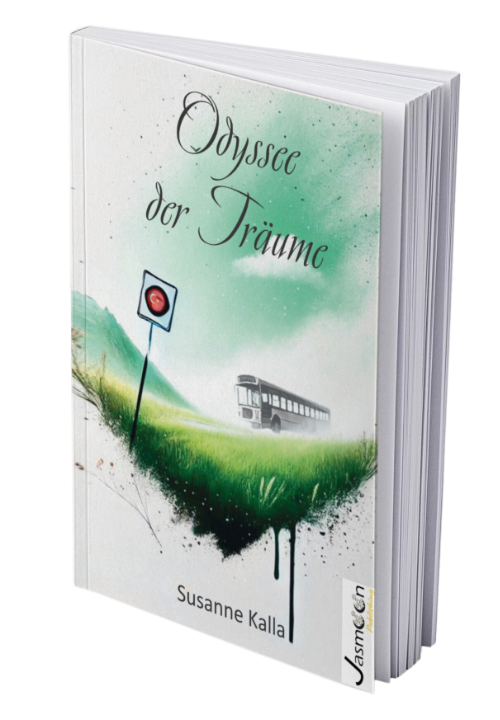
DREAMS BEYOND BORDERS
Novel (1st chapter)
- 1 -
AUSTRIA BEGINS AFTER THE EXIT
“Sit down properly!”
“Excuse me?”
"You heard me perfectly. Either you sit down properly or you leave my restaurant. Any exchange of affection is forbidden in my establishment."
"You seriously want to forbid me from putting my arm around my wife?"
"I do not tolerate sexuality in my restaurant. Stick to my rules or get out!"
"You do realise that we're in Austria and this is a free country ..."
"Austria begins after the exit. Now get lost!"
Mia stood - as usual - at a safe distance at the bar. Her head was pounding. Like dark grey rain clouds, the events she had experienced over and over again accumulated. Until they erupted in a heavy rumble of thunder. The man, who was no more than forty years old, had stood up so abruptly that the small square table had rumbled to one side. His dapper companion had widened her eyes as if Godzilla were running towards them with arms outstretched wide. Mia felt like she was in an endless loop. Waiting for the guest's angrily choked out 'Fucking foreigner!', which Milan recognised as the starting signal to take action. Aware of the cameras on the ceiling and in the picture frames on the walls. This fact dictated that the disobedient offender should only be held gently by the arm and then escorted out with unemotional vigour. If the customer or his entourage showed any resistance, he would skilfully position himself so that his hands would not be visible in any camera shots. After seven years in this business, he knew exactly how to look good in court even after a customer's nose had been broken. There was no social network on the internet and no local newspaper in which the 'Allegria' had not already been mentioned negatively. In newspapers compulsively factual, on websites of various groups emotional and honest.
"A normal human would be ashamed and expatriate," Kevin used to say.
But Milan saw every mention, no matter how dripping with negativity, as publicity. How she hated it! Sometimes she was at odds with herself about who she despised more. Milan for his boundless arrogance, this inhuman self-importance - or Lena, who was the restaurant manager on paper but as soon as Milan felt the need to spout his sick moods, stood there as if she was suddenly unable to speak. Lena put on her legendary 'I can't do anything, I'm just a tiny cog in this microcosm' face and tensely tried to wring a placating smile out of herself. In an act of comedic display of her coarse teeth. With a hand gesture bordering on lasciviousness, she brushed a non-existent strand of hair from her tomboyish-looking, blue-black coloured short hairstyle out of her overly made-up face. She searched the black, gleaming granite slab for an occupation with a smile locked in place. Relieved, she reached for the yellow cloth at the sink and routinely moved it around in gentle circles. Over the entire bar area. As if the shine of the stone slab that Milan was so proud of could be doubled by compulsive wiping.
He was convinced that he was the only person in the city, if not the whole country, to have such a perfectly grained and crafted grey stone slab as a bar surface. His overconfidence had made him an expert in granite and marble. At least worldwide. In contrast to the craftsmen who realised his construction plans, usually without an invoice. Whether he considered them loyal was a highly irrelevant factor. They were supposedly teenage friends. And happy to divulge some of their client's secrets. For coffee and coke. Mia and Kevin lapped up all the details like the last of the strawberry milk in the glass. Neither of the two service-staff could remember the name of the small village in the far south of Kabul where Milan was born. But the stories of his compatriots and contemporary witnesses were engraved in their minds. With the colourful, saturated presentation of all the details worth knowing about the meagre life of a young petty criminal.
Hasan, the Afghan tiler, swore that his statements were one hundred per cent trustworthy. Gesticulating wildly, he told about Milan's escape over the mountains to Pakistan. Whether he first silvered the stolen heroin from his former religious comrades there in order to get to India, or used the stolen drugs to buy escape assistance in Afghanistan, did not detract from the horrendous story. Neither did the small gap in his biography, which allowed speculation about the date of his name change, but was certainly linked to the loss of his full beard. The stamp of a religious bigot with criminal tendencies was imprinted on him. Waterproof. Hasan put it aptly in moderate Swiss German, which was slightly amusing considering his appearance: "With Taliban the turban stayed on the head, with Milan in the head."
How he had met, or rather found, Helga, the charmless, chubby, bespectacled Austrian court official, remained a mystery. How he had managed to persuade her to marry him and thus pave the legal way for him to enter her socially secure, clean homeland was a far greater mystery. He enjoyed his first few months in Austria, at an almost endless distance from his former henchmen, at the expense of his passably well-off wife. Between her paid-off condominium and various betting shops. Until Helga's savings paved the way for him to open a business selling stone figures for outdoor use.
The issue of his trade licence transformed him from a gambler and day thief into a serious businessman. Just like the frog became a prince, whom Helga soon regretted not having knocked against the wall. After just under a year, not only was the marriage in tatters, but also the head of the kind-hearted but unfortunately unworldly wife. Ugly scars scattered across her body, together with a fractured skull base, bore witness to the relationship drama of this marriage. The business also succumbed to bankruptcy. The latter was hardly surprising, as Milan, according to eyewitnesses, led a lifestyle as if he had a worldwide monopoly on all available stone products. He consistently kept quiet about his alleged or rather well-known bankruptcy. Nobody dared to ask him about it, provoking a loud monologue that would undoubtedly end in a fit of rage.
When Lena was under psychological stress - as she was now - her gait seemed clumsier than usual. Visually supported by her always flat, black brand shoes. Classic and inconspicuous, with the sex appeal of a nun. As she stomped along the bar with heavy steps, she seemed to be talking to herself. Silently. With grotesque, constantly changing facial expressions. Accompanied by almost incessant blinking. That was her way of controlling herself. She was probably seething inside and would have loved to throw up her opinion, which had been reserved for far too long, in Milan's face. But maybe not. Nobody knew that. Just as no one could imagine her life outside the 'Allegria'. Not a soul seemed to have ever set foot in the tiny flat near the airport that she shared with her brother. Behaviourally idiosyncratic or mentally retarded. Opinions were divided. Apart from two or three prostitutes on the top floor, most of the residents of the shabby block from the seventies were no longer youngsters. It was understandable that they preferred to concern themselves with the course of their own final years rather than those of their fellow residents. The meagre information about Lena's far more meagre private life came from the postman, who was related by marriage to one of the Afghan craftsmen and, fortunately for those interested, was quite talkative. He simply labelled Lena's brother a 'lunatic'.
As usual, Kevin wished for a hole in the floor so that he could disappear into it forever. After unsuccessfully combing the dark brown tiled floor behind the counter with lowered eyes, he sought Mia's eye contact. How glad he was that she also worked in this psycho shed. He couldn't think of a more drastic name for the 'Allegria'. She made the working days feel shorter. Especially those rare days when he worked alone with her over lunchtime while Lena enjoyed her sparse free time and Milan pursued his dodgy appointments. Officially, he did the shopping for the restaurant. Meanwhile, his employees enjoyed the lighter moments in the midday hustle and bustle. Looking into Mia's brown eyes, a smile broke free of Kevin's tension. Her thoughts seemed to spread out before him: »Ya know where I'll run off to when I've had enough of this dictator? To Tajikistan. The most perfect of all countries. 70 per cent of the people don't know where it is, and the others have no idea how to get there. The language is impossible to learn, and between all the sheep and the people I never have to talk to, I'll be happy.«
Kevin remembered that Mia didn't laugh at this statement. Although he also belonged to the said 70 per cent, it was even worse that he lacked clarity about how he felt about her. All he knew was that he would find her if she was ever gone. Even if his mother wouldn't understand adventures of this kind. Even with the certainty that she would carry out her threat to rent out his room overlooking the backyard to a student. One who appreciated her commitment to the household.
"Let those two perverts live out their urges wherever they want!" rumbled Milan and stomped behind the bar.
The look of disgust on his face was always the best proof for Mia of his unsatisfactory lifestyle. She took a deep breath. A mixture of coffee, which Kevin was brewing for table five, and Lena's vulgar perfume crept into her nose. With raised eyebrows, she gave her work colleague a cursory glance and set about attending to the guests after the incident. The two German tourists from table twelve ordered two portions of spaghetti carbonara. Mia accepted their order with a smile and a "Great choice! Thank you!." Inwardly, she felt sorry for them in front of the expensive plate of pasta. Cooked by an Austrian chef, but under Milan's instructions with lots of onion, the cheapest sauce powder in the cream and poor quality pressed ham. The occasional mouldy edge cut off, of course. Mia had got used to the fact that she would never see many of her guests again. It had been six months since Ferenc, the Hungarian chef, had disappeared one evening and never reappeared, as if he had vanished from the face of the earth. It was anyone's guess that his black eye on his last day at work was not the result of a dropped saucepan. But nobody wanted to bring it up in Milan's presence. Not even Ferenc's limp the day before and the countless bruises on this skinny little man's arms.
When Kevin crossed Mia's path, she would have liked to run her fingers through the blond, always neatly cut, short hair. But she didn't. As always. If only because of Milan, who was watching his employees on the monstrous screen in the office next to the drinks store in the basement. As he walked down the stairs, he turned round briefly and grinned at her. Creepy. With the unmistakable message that he not only didn't care about the ban on monitoring employees using cameras, but that he would even save these recordings. Austrian law was a laughing stock for him. Every violation of the law that had so far been decided in his favour in court, for fathom reasons, reinforced his reprehensible thoughts and actions.
Mia looked at the clock: 2.30 p.m. Her last half hour of work for the day had begun. She sincerely hoped that the guests would not be homosexual, disabled or otherwise deviant in Milan's eyes before she finished work. The embarrassingly small portions of inferior food she served with a winning smile. If necessary, with an additional funny phrase. In the hope of giving the guests the feeling that the food had been prepared with love instead of by an underpaid chef who had been forced to work unpaid overtime. The shiny hand on the tasteless stainless steel clock on the ochre-coloured wall behind the coffee machine had finally jumped to twelve, with its shorter, black counterpart pointing to three. Time to fold up her apron and put it away in the cupboard next to the bar.
Lena fiddled intently with payment slips. Ready to present them to Milan for verification. This usually took a little over an hour, and nobody dared disturb them during that time. Especially since that day when one of the guests complained loudly about the food and Lena had to be called. She or Milan should have seen the incident on the camera recording. Actually. After what must have been the eighth ring of the phone, Lena had trudged up the stairs with her hair dishevelled and an unmistakably irritated expression on her face. An occasional little fling with a rattling despot as the highlight of Lena's unfortunate life was probably considered unspeakably sad by everyone involved in this scene. Except for Mariella, who to all appearances had no idea about such escapades on the part of her partner and arbiter.
"Ciao, Lena!" Mia said politely, but as unemotionally as possible, and took a step into the tiny kitchen to wish Peter a good day. Every day, the same question arose as to whether the cook heard a well-intentioned wish or sheer sarcasm. On duty seven days a week from ten in the morning until ten at night. With no opportunity to practise the professional skills he had learnt and trained for years. From passionate cook to Milan's apprentice. Defencelessly exposed to his whims, his every move dictated. And all for far less pay than he was entitled to for the hours he worked. Peter was the best example of how growing old was nothing to look forward to. As always, he thanked for the kind words.
The politely wrested smile landed on Mia like a knife blade before he set about scrubbing the dirty pots and pans again. All that remained was to hope that one of the large steel containers didn't fall on his head or even his face like its downtrodden predecessor.
"See you tomorrow, and have fun!" she called to Kevin, who was serving newly arrived guests, in a subdued voice and with a twinkle. Without waiting for his reply, she disappeared.
How glad she was to be rid for the day of this odour-intensive mess of grease and reheated food from the microwave, infused with the aroma of freshly brewed, shallow coffee, the sweat of the guests and their sometimes heavy, sometimes cheap, intrusive perfumes. The breath-hardening smoke from the smoking area had eaten into her clothes and accompanied her home. As at the end of every working day, she symbolically left all events behind the doorstep of the pub. Usually successfully, but sometimes not at all. This ritual was one of the few habits she had picked up from her mother.
Mia savoured the warming sun of the early May day and took a deep breath. Then she took a few steps across the small car park to the town's busiest street. She only glanced briefly at the stately, historic building at the end of the bridge with its unadorned metal railings. With a sigh at the absurdity of the proximity of the 'Allegria' to the courthouse, she deliberately turned her eyes to the ancient water tower in front of her. Today, Mia avoided the route to the railway station via the main street and instead walked quickly through the historic old town. She liked the mixture of almost unadulterated, beautifully restored houses and tasteful, concept-orientated shops, restaurants and cafés under the arcades. One day she would find time to eat a slice of Black Forest gateau at the neatly arranged tables and chairs on the old pavement in front of the arcades.
She liked Feldkirch. It was smaller, more manageable and cosier than Innsbruck and fortunately not visited by the whole world. The proximity to the border with Liechtenstein and Switzerland did affect the language somewhat, but after five years she had largely overcome this hurdle. At least in terms of understanding. After just under a year in a moderately paid but regular job in an import-export company in Innsbruck, she was happy to be able to move with Paul. Importing gemstones from India, China and Africa to adorn tourists was not exactly Mia's dream of a satisfying job. On top of that, there was the journey to work through the hugely populated old town. Past souvenir shops selling bric-a-brac and pubs that had placed their seating areas directly and profitably on the cobbled paths besieged by thousands of tourists and strolling locals. The paying guests had to be guaranteed a view of the world-famous 'Golden Roof' even when seated. The mere thought of it made her feel uneasy. She also never liked the manifest waste of taxpayers' money in the form of the abstruse red station forecourt and the newly designed, cool-looking station concourse. The fact that the change of location would only bring Paul closer to his professional goal was not yet foreseeable at the time of the move.
She completed her daily walk through the old cobbled streets lined with no-frills houses with her usual consistency. Without allowing herself to be distracted. After all, the train wouldn't wait. As always, she scurried through the same arch of the thick walls, leaving the centre of the town's history behind her, took a quick look at the 'Shadow Castle' that towers imperiously over the historic settlement and hurried along the edge of the public car park to the old gymnasium. »The education of the people for the fatherland ... July 1904« was chiselled in block letters on the stone plaque above the entrance. Not just today Mia regretted that she had missed the heyday of physical education more than a hundred years ago. She hurried on. Past the small Protestant cemetery and the new blocks of flats with the closed metal railings on the balconies, always with the railway tracks on her right, quickly striding towards her destination. Straight towards the marble-covered subway. Mia knew the shortest route to her platform. Nevertheless, she allowed herself the luxury of turning into the small alley just before the bulky entry and taking the path across the stone passageway to the station forecourt.
Her last glance before entering the modest station concourse was to the left, as she did every day. Towards the bus stop at the edge of the site, separate from the local transport stops. This was where buses to former Yugoslavian countries, Turkey and who knows where else left on Fridays. Mia was convinced that there was also a bus to Tajikistan. On Fridays. But there was no bus there today. After all, it was Wednesday.
The train was on time and not very busy, as is usually the case at this time of day. Without having to race against scholars, officials and other passengers, she managed to get one of the coveted seats by the window. It wasn't hard to tell how she earned her money from her all-black outfit, complemented by comfortable black shoes, and even more so from the smell that clung to her. She watched the passengers. Compared herself with one or other of her fellow travellers. Wished, as she often did, that she could change at the end of her shift. Without having to wait half an hour for the next train. She shrugged her shoulders inwardly. She was not accountable to anyone, nor did this circumstance seem dramatic to her. What she found far more alarming was that she was as tired every day after six hours of work as if she had been hammering stones in a mine for a double shift.
Mia pulled the well-worn, never-ending novel by Hermann Hesse out of her bag. Unfortunately, she couldn't concentrate on the contents. The person opposite her, a blonde, chavvy-looking woman her own age, was shouting a blue streak into her smartphone. Mia wondered why she was even using a phone at this volume. She had to laugh at this foolish thought and turned her head towards the window. In places, she could vaguely recognise her face, or at least the contours of her features. This view into the window was much more appealing to her than the one into the mirror. It showed neither traces of physical strain nor worry lines or even the emptiness in her face after a day like today. 'Sit down properly!' Milan's rebuke to the guests was still pounding in her head. His large, round, puffy face with its expressive dark eyes under bushy, black brows, large bulbous nose and upturned trout lips that led into an almost infinite emptiness didn't seem to want to disappear from her thoughts. The more she tried to concentrate on something else, the more present Milan became. She heard him laughing. He was laughing about her. Without a doubt. Even when she turned the volume control of her mind to 'off', his demonic grin remained. With teeth capped far too white in his oversized moon face. The image in her head disgusted her to no end. Just like the permanently reddened, bulging scar on the lower half of his right cheek.
A well-tended landscape passed by the train window. The sun shone gently on it and a light breeze brushed across the blossoming trees. Mia scolded herself for not being able to switch off from her unloved work even on such a glorious spring day. The 20 kilometre train journey seemed endless. She closed the book halfway through the journey. Without having read a single paragraph. The blonde, chubby woman was still maltreating the phone with the glittering case in her hand. The person on the other end of the line, who was obviously severely hearing-impaired, regrettably failed to notice how she continued to adjust her oversized cleavage. The gossip of a village on the railway line poured out of her unrestrained. Precisely detailed. From the contents of the eco-neighbour's rubbish bin to the items stored in the cellar compartment of the retired policeman on the fourth floor. She seemed to keep a record of how often the 'weird chick who never had to work a day in her life but had inherited the house at the end of the street' cleaned her windows, who was arguing with whom and when, and who got out of whose bed in the morning. With a presumably endless list of other obscure information that Mia was fortunately spared. She sighed with relief when the woman, her white handbag in one hand and her mobile phone pressed to her ear with the other, got off the train one stop before her, laughing hysterically. Glad to get back to her relatively orderly life.
It was only when the synthesised voice on the train announced 'Altach' that Mia realised that her hair was still tied back in a ponytail, as Milan had ordered. As she got off the train, she quickly undid the hair tie and shook her long brown hair, which would have benefited from a new cut or at least a trim of the ends. But Mia preferred to spend her money on her future with Paul rather than on mundane vanities. Simplicity was the magic word. Like the railway station where she lived. A station that was praised as architecturally sophisticated, but nevertheless meaningless. Just like the gymnasium from 1904, she regretted not having experienced its heyday. In symbiosis with the happy times of the chestnut tree on the other side of the street. Before the couple were robbed of their friendship and dignity by one or more career-minded builders.
The walk home took almost exactly ten minutes. Thanks to certain residents of an old red house opposite the station, it usually took her 20. Today was one of those days. Mrs Stermon's hearing had suffered badly from the passing trains for more than 40 years. She busily handled the rubbish bins. It was unclear whether she was about to fill or empty them. "Have a nice day," Mia called to her as the old lady looked over at her. Mrs Stermon, dressed in a colourful apron that picked up on the red of her always tangled hair, smiled and shook her head. "Are you all right, Mrs Stermon?" called Mia, who was standing just three metres away from her.
"Yes, yes, dear. I'm just wondering why you're always dressed in black. Do you think that's nice? A young person like you should wear colourful clothes."
As she did every time, Mia explained to her at a volume that the whole street could hear that she had come from work and was dressed like that. The thought that at least she wouldn't have to tell the rest of the street about her clothing preferences made her laugh. The question remained whether her hearing was the only thing that the passing trains had damaged in Mrs Stermon. "Don't work too hard!" Mia called out to her, but Mrs Stermon was back at the bins and carried on working.
At the end of the garden fence patrolled another resident of the red house: Mrs Helbert. Also today she was tastefully dressed with matching jewellery. Sometimes gold, sometimes costume jewellery, today a long necklace of oval horn links with a matching bracelet. Accompanied by subtle make-up and her neat, shoulder-length black hair held back at the nape of her neck with a silver barrette. "It's a drama, the way Mrs Stermon is going downhill, don't you think?"
"I think Mrs Stermon has been the same as ever since I've known her."
"Just as confused as ever, maybe. But the fact that she's now rearranging the contents of the bins is strange, isn't it? And the cards don't predict anything good either, even pointing to a sudden death in the house."
"She probably has a different idea of rubbish sorting," Mia scoffed, "and I think card reading is rubbish. How are you supposed to be able to see the future from printed cardboard?"
Mrs Helbert simultaneously pulled down the corners of her mouth, raised her eyebrows and tilted her head to one side. "Maybe I should take a look at your cards. Who knows what fate has in store for you? How's your husband, by the way? Or are you still not married? Well - maybe that's for the best." She said 'husband' in a tone of voice as if she wanted to say 'chimpanzee', only to use a more pleasing synonym.
"My husband is fine; thank you for asking, Mrs Helbert," Mia replied as she glanced briefly at the plain silver ring on her right ring finger.
The older lady had followed her gaze and, without the slightest attempt to hide the horror on her face or to think her words over beforehand, interjected: "So the cards weren't lying after all. I just misinterpreted the doom card."
"I'm sure you understand that I have to hurry home. After all, I have work waiting for me there too."
"Yes, darling, hurry up to fulfil your work. And ... take care of yourself!"
"Thank you, I'll do my best. You too, Mrs Helbert." Mia didn't like Mrs Helbert very much. Firstly because of her inexplicable aversion to Paul, and secondly because she reminded her of her mother. They could easily have been mistaken for sisters. Not only because of their similar appearance. The way they spoke and gesticulated also had striking similarities. And then there was the unanimous dislike of Paul! It was almost frightening. If Mia, like her mother, were esoterically inclined, she would agree that the encounter with Mrs Helbert could be interpreted as fateful. But she didn't believe in the supernatural, esoteric or spiritual. At least she went to great lengths to avoid coming into contact with it. Her booklet of affirmations by Louise L. Hay may have lacked a scientific foundation. But it couldn't be compared with card reading or other esoteric rubbish. In the end, the theory of fate gave way in favour of the belief in coincidence. The similarity was ultimately based on her last contact with her mother six years ago. Who knows how she had changed in that time. Perhaps, apart from her aversion to Paul, she bore no resemblance to Mrs Helbert.
The only thing Mia had in common with the older lady was the German accent that still clung to her. This was more justified for Mia than for Marlene Helbert, who had lived in this house for 35 years and had been married to a genuine Vorarlbergian for at least as long. Until he died three years ago on one of his beloved mountains. Mia's way of speaking had clearly changed in the six years she had lived in Altach. At least according to her own judgement. But she still couldn't completely hide her North German origins. At that moment, she didn't care. Inspired by the anticipation of her cosy home, she quickened her pace.
_______________________________________________________________
The plot and all characters are fictitious. Any similarity to living or real persons would be purely coincidental. This novel is the completely revised version of my novel ‘Bus to Tajikistan’, which was published by Berenkamp Verlag in 2017.
© All rights reserved
The work, including all its parts, is protected by copyright. Any utilisation, reproduction, transmission or data storage of the work without the consent of the publisher is prohibited and punishable. All rights, including those of reprinting and translation, even in part, are reserved!